The Trillion-Dollar Alliance: Why Meta is Paying Billions to Use Google’s AI Chips!
Unbelievable twist in the AI War! Mark Zuckerberg has just signed a massive deal to rent Google’s secret AI chips (TPUs) to build the next Llama 4 models. Find out why Meta is ditching Nvidia and joining forces with its biggest rival, Google, in March 2026.
AI NEWS
3/3/20263 min read
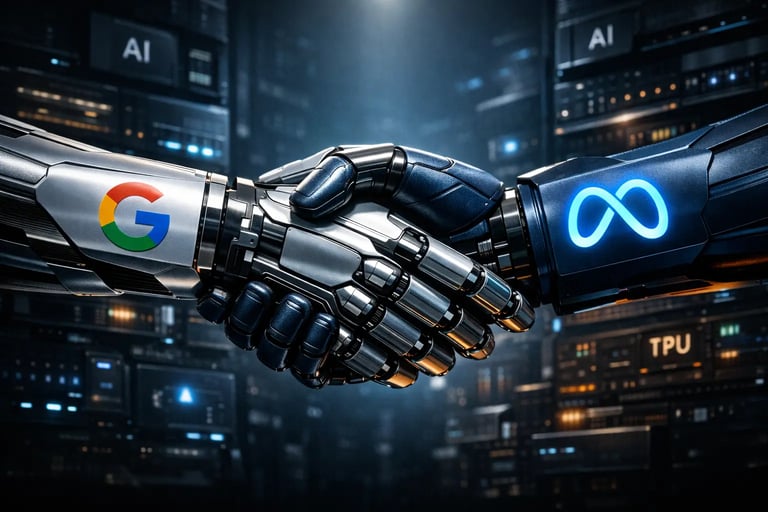

Meta & Google: The Unexpected Partnership Shaping 2026
In a strategic shift that caught the tech world off guard, Meta Platforms has officially signed a multi-billion dollar agreement to lease Google’s Tensor Processing Units (TPUs). For years, Meta and Google have competed intensely in digital advertising and artificial intelligence. However, the overwhelming demand for raw compute power has driven these two tech giants into an infrastructure alliance.
Here is what is driving this historic deal and how it redefines the global AI landscape.
Why Now? The Global Compute Bottleneck and Nvidia Shortage
Even as the AI market expands rapidly, high-end Graphics Processing Units (GPUs)—particularly from Nvidia—remain extremely expensive and constrained by supply chain limits.
Mark Zuckerberg’s ambitious plans to train Llama 4 and scale next-generation foundation models require massive infrastructure. By adopting a hybrid silicon strategy that includes renting Google’s custom-built TPUs alongside Nvidia and AMD chips, Meta secures critical compute capacity while optimizing training costs.
Benefits for Both Tech Giants:
For Meta: Diversifies hardware suppliers, mitigates reliance on a single vendor, and reduces operational bottlenecks for Llama model training.
For Google Cloud: Validates the commercial viability of its Ironwood TPUs for enterprise clients, positioning Google Cloud as a primary infrastructure provider even for direct competitors.
Powering "Agentic AI" Across Instagram and WhatsApp
This alliance extends beyond simple chat interface improvements. The vast compute capacity provided by Google’s Ironwood TPU pods is specifically optimized to power Agentic AI—autonomous systems capable of executing multi-step actions across digital ecosystems.
Key Capabilities Coming to Meta’s Ecosystem:
Small Business Automation: Autonomous AI agents capable of managing inventory, processing customer inquiries, and handling order routing in WhatsApp.
Automated Scheduling: Smart assistant capabilities that communicate directly with other business AI systems to organize meetings and appointments.
Autonomous Content Creation: Advanced multimodal processing to assist creators in editing and publishing short-form video content directly on Instagram.
A Structural Shift in the AI Triad
This agreement signals a major realignment in tech infrastructure. Where the market previously centered on singular vendor reliance, a dual-power dynamic is taking shape:
The OpenAI & Microsoft Ecosystem: Combining massive proprietary model deployment with dedicated cloud infrastructure.
The Google & Meta Infrastructure Alliance: Pairing open-weight foundation model innovation (Llama series) with scale-out custom TPU processing.
With global capital expenditures for data centers exceeding hundreds of billions this year alone, co-opetition (cooperation between competitors) is becoming an operational necessity.
What This Means for Privacy and End Users
For daily users, Meta’s integration of expanded compute capacity means AI features will operate with noticeably lower latency and higher reliability across social platforms.
However, tech policy experts note that cross-infrastructure partnerships bring heightened scrutiny regarding data handling. Both Meta and Google maintain that rented cloud TPU hardware operates as isolated, neutral compute environments, though privacy advocacy groups continue to call for independent security audits.
Conclusion: The Era of Pragmatic AI Infrastructure
The Meta-Google partnership demonstrates a clear market reality: the race toward Artificial General Intelligence (AGI) demands unprecedented infrastructure efficiency. In an industry defined by massive capital investment, permanent interests in compute capacity take precedence over traditional rivalries.
Frequently Asked Questions (FAQs)
1. Why is Meta using Google TPUs instead of Nvidia GPUs?
Meta is implementing a multi-vendor hardware strategy. Due to Nvidia GPU supply constraints and high procurement costs, renting Google’s Ironwood TPUs provides immediate access to high-performance compute required for training large models like Llama 4.
2. Is Meta sharing its proprietary user data with Google?
No. Meta is renting raw compute capacity through Google Cloud infrastructure, where processing environments are isolated, meaning user data remains within Meta's platform architecture.
3. What is Agentic AI and how will Meta use it?
Agentic AI refers to autonomous systems that perform multi-step workflows. Meta plans to deploy these agents across WhatsApp and Instagram to handle automated business tasks, appointment bookings, and media editing.
4. What are Google Ironwood TPUs?
Ironwood TPUs are Google's custom-designed Tensor Processing Units optimized specifically for large-scale machine learning, deep learning, and AI model inference.
Aap is formatted content ko copy-paste karke apni Hostinger/WordPress site par directly publish kar sakti ho! Iska layout mobile-friendly aur SEO-ready hai. 🚀