OpenAI’s $110 Billion Deal: Sam Altman Enters the Pentagon While Anthropic is Banned!
The AI war has moved to the battlefield. OpenAI has just signed a landmark agreement with the U.S. Department of War to deploy its models in classified networks. As President Trump bans Anthropic, Sam Altman’s OpenAI secures $110 billion in funding to lead the military AI revolution. Here’s what it means for global security.
AI NEWS
3/3/20262 min read

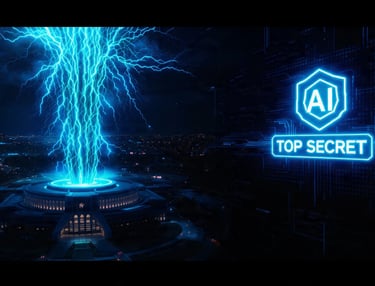
OpenAI and the Pentagon: A New Era of Military Intelligence
In a move that has sent shockwaves through Silicon Valley and Washington D.C., OpenAI has officially signed a multi-billion dollar deal with the U.S. Department of Defense. This announcement comes shortly after the company closed a record-breaking $110 billion funding round backed by tech giants including NVIDIA, SoftBank, and Amazon.
The partnership signals a fundamental evolution in how frontier artificial intelligence is deployed, shifting from consumer tools to core national security infrastructure.
The Anthropic Ban and Silicon Valley’s Pivotal Shift
The timing of this defense agreement is critical. Following regulatory friction and federal restrictions placed on Anthropic due to supply chain compliance policies, federal agencies sought reliable enterprise AI partners capable of operating within classified cloud architectures.
Sam Altman moved rapidly to bridge this gap, positioning OpenAI as the primary technology partner for the United States government’s classified artificial intelligence requirements.
Non-Negotiable Safety Guardrails and Contractual "Red Lines"
To address public concerns regarding the operational boundary of military artificial intelligence, OpenAI outlined clear contractual constraints governing its deployment across defense networks.
Core Safety Commitments:
Prohibition on Domestic Mass Surveillance: The artificial intelligence infrastructure will not be utilized to monitor, target, or aggregate data on U.S. citizens, adhering strictly to constitutional privacy protections.
Mandatory Human Accountability: Strategic decision-making regarding the application of force remains entirely under human control, restricting AI capabilities strictly to logistics optimization, cybersecurity defense, and operational intelligence synthesis.
The $110 Billion Capital Expansion and Autonomous Workflows
Achieving a historic $730 billion valuation, OpenAI has solidified its status as a global infrastructure provider rather than a standalone software developer. A major portion of this capital expansion is dedicated to engineering a Stateful Runtime Environment for autonomous agents.
This technical framework allows AI systems to preserve operational context across multi-week timelines, enabling long-running data synthesis and threat monitoring without continuous manual intervention.
Sora: Dual-Use Multimodal Technology in Defense and Entertainment
A core component of OpenAI's strategy involves the expansion of Sora, its advanced video generation model. While global entertainment leaders utilize Sora for high-end digital media production, defense agencies are leveraging high-fidelity synthetic video generation for battlefield simulation environments and tactical mission planning.
This dual-use strategy makes OpenAI one of the most influential technology entities in modern computing history.
Conclusion: From Conversational Chatbots to National Infrastructure
The strategic alliance between OpenAI and the Department of Defense represents a major turning point in modern technology. As artificial intelligence moves away from basic conversational interfaces toward foundational national defense infrastructure, OpenAI is helping redefine the future of military intelligence and technological strategy.
Frequently Asked Questions (FAQs)
1. What is the scope of the OpenAI and Pentagon agreement?
The agreement enables OpenAI to deploy advanced AI models across classified Department of Defense cloud environments to assist in logistics, cybersecurity analysis, and operational intelligence synthesis.
2. Can OpenAI models be used in autonomous military hardware?
No. The contract includes non-negotiable safety guardrails requiring human decision-makers to maintain absolute control over strategic operational actions and lethal force applications.
3. What is a Stateful Runtime Environment in military AI?
A Stateful Runtime Environment allows AI agents to retain long-term memory and operational state over extended periods, executing multi-step analytical workflows for weeks without resetting session data.
4. How does Sora technology apply to defense operations?
While Sora is widely used commercially for high-end digital video production, defense agencies utilize its visual generation capabilities to construct immersive battlefield simulations and training environments.