Computer Vision Engineer: Giving Sight to Machines
From self-driving cars to medical imaging, Computer Vision Engineers are teaching AI how to see and understand the visual world.
AI JOBS
3/5/20262 min read
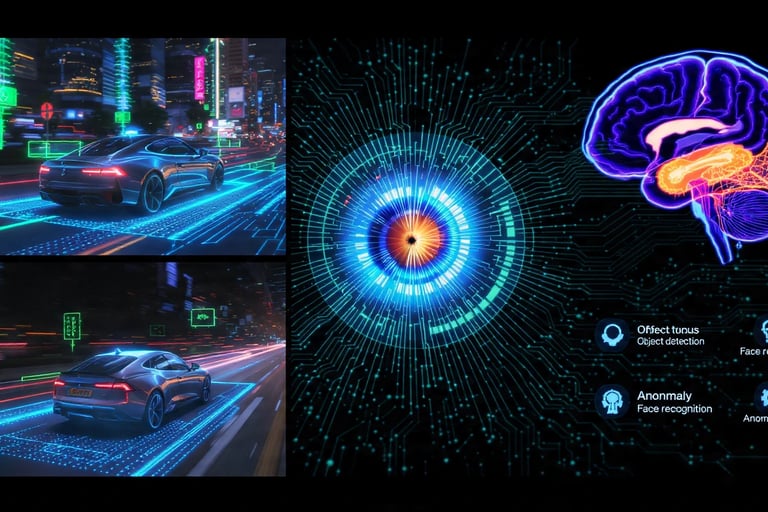
The Eyes of Artificial Intelligence: The Rise of the Computer Vision Engineer
Computer Vision stands as one of the most transformative branches of modern artificial intelligence. Focused on enabling software to perceive, process, and analyze visual data much like the human visual cortex, this discipline turns raw imagery into actionable insight.
A Computer Vision (CV) Engineer is the technical specialist who builds the algorithms and deep learning models that allow machines to "see," interpret, and respond to their visual environment in real time.
What Does a Computer Vision Engineer Do?
A Computer Vision Engineer operates at the intersection of spatial mathematics, deep learning, and digital signal processing. They design software systems capable of extracting meaning from high-dimensional visual inputs—such as live camera feeds, satellite imagery, and medical scans.
Primary Core Applications:
Autonomous Navigation: Engineering perception systems for self-driving vehicles and delivery drones to detect lanes, recognize traffic signs, and avoid obstacles in adverse weather.
Biometric & Security Systems:
Developing high-accuracy facial recognition algorithms (such as smartphone authentication) that function reliably across complex lighting conditions.Medical Diagnostic Imaging:
Building deep learning models that assist radiologists by identifying subtle anomalies, micro-fractures, or early-stage tumors in X-rays, CT scans, and MRIs.Industrial & Agricultural Automation:
Deploying visual inspection models on factory lines to detect micro-defects or operating autonomous farm equipment to monitor crop health.
Why Computer Vision is Booming in 2026
As autonomous systems, spatial computing, and robotics expand across global industries, modern hardware increasingly depends on visual perception.
Whether it is an e-commerce fulfillment robot sorting packages, a retail system offering cashierless checkout, or an Augmented Reality (AR) headset mapping physical rooms, visual automation has become essential. In 2026, companies spanning healthcare, security, agriculture, and automotive technology are aggressively recruiting experts who can construct robust machine sight systems.
Essential Skills for Computer Vision Engineers
Building reliable visual recognition software requires a specialized technical foundation across software development, deep learning, and applied mathematics:
Digital Image Processing: Understanding spatial filtering, edge detection, color space transformations, and matrix representations of visual data.
Deep Learning Frameworks:
Mastery of Convolutional Neural Networks (CNNs), Vision Transformers (ViTs), and deep learning libraries like PyTorch or TensorFlow.Core Programming & Libraries:
High proficiency in Python (for model training) and C++ (for low-latency real-time deployment), along with computer vision libraries like OpenCV.Applied Mathematics:
Strong expertise in linear algebra, multivariable calculus, and spatial geometry for 3D mapping, camera calibration, and object tracking.
Conclusion: Engineering Machine Perception
For professionals captivated by how digital systems interact with the physical world, pursuing a career as a Computer Vision Engineer provides a high-impact path. It is a field where developers can directly observe the real-world output of their algorithms in real time.
As the world transitions toward autonomous transportation, augmented reality, and automated diagnostics, the engineers who build "machine sight" will remain at the forefront of digital innovation.
Frequently Asked Questions (FAQs)
1. What is a Computer Vision Engineer?
A Computer Vision Engineer is a software specialist who develops algorithms, neural networks, and visual processing pipelines that allow computers to recognize, analyze, and react to images and video.
2. Which programming languages are used in Computer Vision?
Python and C++ are the primary languages. Python is extensively used for research, data preprocessing, and model development, while C++ is essential for high-performance, real-time edge execution (such as in autonomous vehicles and robotics).
3. What is the difference between Image Processing and Computer Vision?
Image Processing focuses on transforming or enhancing an image (such as sharpening, blurring, or color correction), whereas Computer Vision focuses on understanding and extracting high-level semantic meaning from an image (such as identifying objects, reading text, or tracking motion).
4. What industries hire Computer Vision Engineers in 2026?
Major hiring industries include autonomous vehicles, medical technology, robotics, security and surveillance, Augmented/Virtual Reality (AR/VR), retail automation, and precision agriculture.