AI Robotics Engineer: Bringing AI into the Physical World
AI isn't just behind screens anymore. Robotics Engineers are building the bodies for the AI brains, creating a new era of automated workers.
AI JOBS
3/5/20262 min read
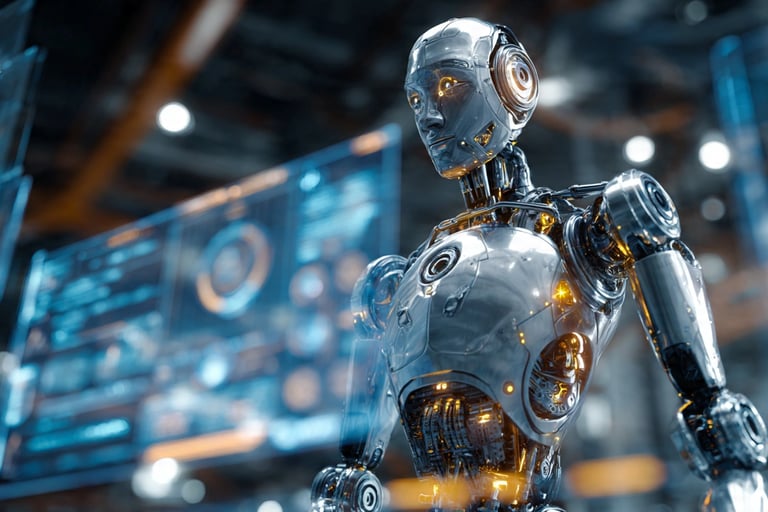
The Fusion of Hardware and Intelligence: The Rise of the AI Robotics Engineer
For years, artificial intelligence was confined primarily to digital software, cloud databases, and conversational chatbots. However, the real technological frontier centers on Robotics. An AI Robotics Engineer bridges the physical and digital worlds by integrating mechanical engineering with modern machine learning frameworks.
Rather than building static automated machinery, these engineers construct autonomous physical systems capable of perceiving, navigating, and learning from dynamic real-world environments.
What Does an AI Robotics Engineer Do?
An AI Robotics Engineer designs physical machines that execute complex operational tasks autonomously. From package delivery drones and surgical robotic systems to humanoid warehouse operators, these engineers program the algorithms that control actuators, motors, and sensory inputs.
Core Responsibilities:
Autonomous Task Execution:
Writing control algorithms that allow robots to move, navigate, and make decisions in real time without human intervention.Reinforcement Learning Implementation:
Training physical systems through trial and error to manipulate delicate objects, balance, and adapt to unpredictable physical spaces.Sensor Fusion Integration:
Combining multi-modal data streams—including computer vision cameras, LIDAR, radar, and tactile force sensors—to build precise environmental maps.Hardware-Software Calibration: Optimizing software code to run efficiently on embedded microcontrollers and edge-computing devices.
Why AI Robotics Engineering is a Top-Demand Career
As manufacturing, healthcare, and logistics operations accelerate toward full automation, global demand for engineers who understand both hardware mechanics and artificial intelligence continues to rise.
Industry pioneers—including Tesla, Boston Dynamics, and Amazon—are investing heavily in next-generation autonomous systems and humanoid robotics. The ability to calibrate physical machinery while writing adaptive machine learning code makes the AI Robotics Engineer one of the most critical contributors to the modern industrial workforce.
Essential Skills for AI Robotics Engineers
Succeeding in this multi-disciplinary domain requires a strong technical foundation across software, hardware, and physical control systems:
Programming Languages:
High proficiency in C++ (for low-latency real-time control) and Python (for machine learning model development and data analysis).Control Systems Engineering: Understanding feedback loops, kinematics, and dynamic motion planning to control robotic movements precisely.
Sensor Fusion & Computer Vision: Processing raw data from LIDAR, infrared cameras, and pressure sensors to provide spatial awareness.
Mechanical & Hardware Fundamentals:
Understanding structural mechanics, gear ratios, and motor electronics to ensure software aligns with physical constraints.
Conclusion: Building the Physical Future of AI
For professionals fascinated by both physical construction and advanced software design, becoming an AI Robotics Engineer offers the unique satisfaction of seeing code execute in the physical world. As artificial intelligence transitions out of server rooms and onto factory floors, warehouses, and surgical suites, robotics engineers serve as the backbone of automated industry.
Frequently Asked Questions (FAQs)
1. What is an AI Robotics Engineer?
An AI Robotics Engineer is a specialized professional who combines mechanical engineering, electronics, and artificial intelligence to design and program autonomous robots capable of learning, navigating, and executing tasks in physical environments.
2. What are the main programming languages used in AI robotics?
C++ and Python are the primary languages. C++ is preferred for low-level hardware control, real-time execution, and memory management, while Python is widely used for machine learning models, computer vision, and rapid prototyping.
3. How does Reinforcement Learning help in robotics?
Reinforcement Learning (RL) allows robots to learn complex physical skills—such as gripping delicate objects, walking over rough terrain, or navigating crowded spaces—by interacting with their environment and optimizing actions based on feedback rewards.
4. Which industries hire AI Robotics Engineers?
Key industries include industrial manufacturing, autonomous vehicle development, e-commerce logistics, medical technology (surgical robotics), aerospace, and consumer electronics.